Sealed or ported subwoofer enclosure: how to choose
A subwoofer is only half of what you hear. The other half is the box it sits in. The same driver sounds tight in one enclosure and loose in another, so the enclosure is designed, not guessed.
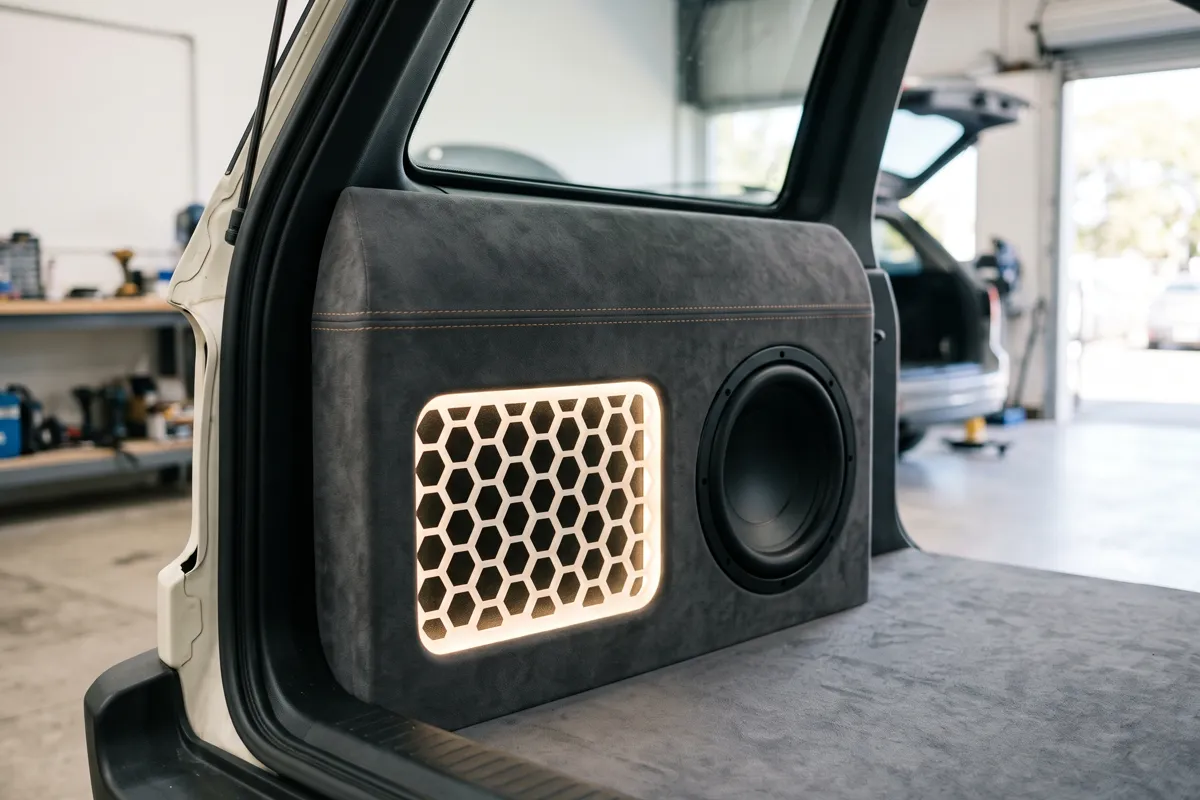
What the box does
A speaker cone moves air on both of its sides. Without a box, the wave from the back meets the wave from the front and the two cancel, most of all in the bass. The enclosure keeps them apart.
The air inside the box also works on the cone. It acts like a spring that helps to control the cone’s movement. How large that volume of air is, and whether it is closed in or vented, shapes the bass you hear.
The sealed enclosure
A sealed box is closed on every side. The trapped air controls the cone firmly, so the bass is tight and even, and it fades gently toward the lowest notes. A sealed box is usually the smaller of the two kinds for the same driver.
It is also the more forgiving design: a small error in volume changes the sound only a little. Its drawback is efficiency. For the same loudness in the deep bass it needs more amplifier power than a ported box does.
The ported enclosure
A ported box has a vent, a tube or a slot of a chosen area and length. The air in the vent and the air in the box are tuned to one frequency. Around that frequency the vent adds to the output, so the box plays louder for the same power.
The gain has conditions. A ported box is larger and must be built to its design closely. Below the tuned frequency the air no longer controls the cone, so a filter that removes the very lowest frequencies is used to protect the driver. A vent that is too small makes a rushing noise.
Volume, rigid panels and airtight joints
The maker of a driver usually publishes the box volume it is meant for. That is the volume of air inside, after the space taken by the driver, the bracing and any vent is taken away. Ask to see the figure the enclosure was designed to.
Panels must be rigid. A panel that flexes turns the driver’s energy into its own noise and blurs the bass, so enclosures are built from dense board such as MDF, or from shaped fibreglass, and braced inside. Every joint must be airtight: a leak in a sealed box whistles and changes how the box behaves.
Where the amplifier goes
An amplifier gives off heat while it works, and it needs moving air around its fins. Do not bury it under carpet or shut it in a closed compartment without airflow. Fix it to a solid panel where it can be reached, and keep it off the enclosure, where it would be shaken all the time.
The power cable needs a fuse close to the battery, and both the cable and the fuse must be sized for the current the amplifier draws. Where a cable passes through metal it needs a rubber grommet. Fix the enclosure to the vehicle too, so that a heavy box cannot move in a sudden stop.