Van flooring and lining: plywood, coatings and fixing
The floor and the lining are among the early things fitted in a working van and the last things anyone notices. They protect the body, give every later fitting something to fix to, and decide how easy the van is to keep clean.
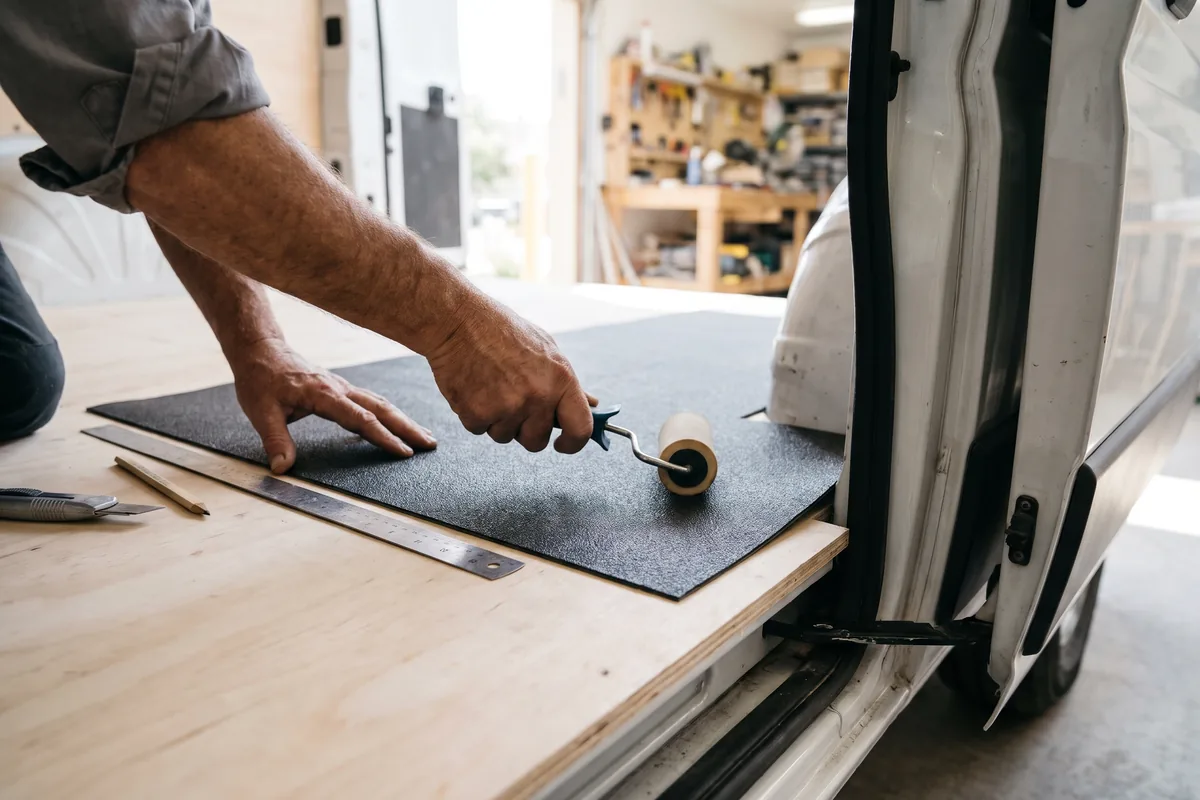
What the floor and lining are for
A bare van floor is thin, ribbed steel. Loads dent it, scratch its paint and leave the metal open to rust. A fitted floor spreads the load over the ribs and gives a flat surface to stand on and slide things across.
Wall lining does the same for the sides. It stops a shifting load from denting the outer panels from inside, and it reduces the noise of an empty metal box. It also gives a clean face that can be wiped down.
The plywood floor
Plywood is the common choice for a van floor. It is strong for its weight, it holds a screw, and it can be cut to the exact outline of the van from a template. The thickness is chosen for the load: heavier point loads need a thicker board.
Plywood and water do not get on. An edge left bare takes up moisture, swells and comes apart in layers. Use a moisture-resistant grade made for this kind of work, and seal every face and every cut edge, including the edges of holes, before the floor goes in.
Coatings and a non-slip surface
The top surface is chosen for the work. A hard coated board with a textured face suits tools and boxes. A sheet of non-slip vinyl or rubber laid over the plywood suits wet work and is easy to wash. A rolled or sprayed coating gives a seamless, tough skin.
Grip matters most when the floor is wet or dusty, and at the doors, where people step in carrying things. In a van that is washed out, the surface should be one sheet turned up at the walls, so water cannot get past the edge.
Seal the edges
Water and dust get under a floor at its edges, at the door thresholds and around fixings. Water trapped between the plywood and the steel is out of sight, and it rusts the van floor where nobody looks. Seal the perimeter and every opening.
The edges at the doors take the most knocks. A metal edge strip protects the board and the covering there. Any bare metal made while fitting, such as a drilled hole or a scratch, is treated against rust before it is covered.
Fix without piercing what is behind
Under a van floor run the fuel tank, fuel lines, brake lines, wiring, the exhaust and, in an electric van, the drive battery. Behind the walls run more wiring and the lamps. Never drill or drive a screw before checking what is on the other side, and choose a fixing length that stops short of it.
Use the van’s own fixing points and lashing points where they exist, and keep the lashing rings usable through the new floor. Where drilling cannot be made safe, a floor or a lining panel can be bonded with adhesive. Leave removable access to the rear lamps and to any wiring that may need attention.